

A Twelve Hour Spring
Winter isn't over, but we had quite the teaser

It was 54 degrees. The sidewalks filled. Dogs tugged their humans down the street in a dry Iditarod. Cyclists reappeared like migrating species of their own. Grinning as the wind swept by their faces. Shorts—actual shorts—were back in circulation on runners everywhere. With a window cracked in hopeful anticipation of the warmth wafting through the car, I heard storm drains that seemed animated, swallowing runoff like they hadn’t had a drink in months. Puddles gathered confidently along the roadways. Downed branches everywhere revealed under the melting of winter’s reign.
For a few hours, it felt like we had collectively agreed: winter is over.
But yesterday morning began differently a few hours before the mercury surged.
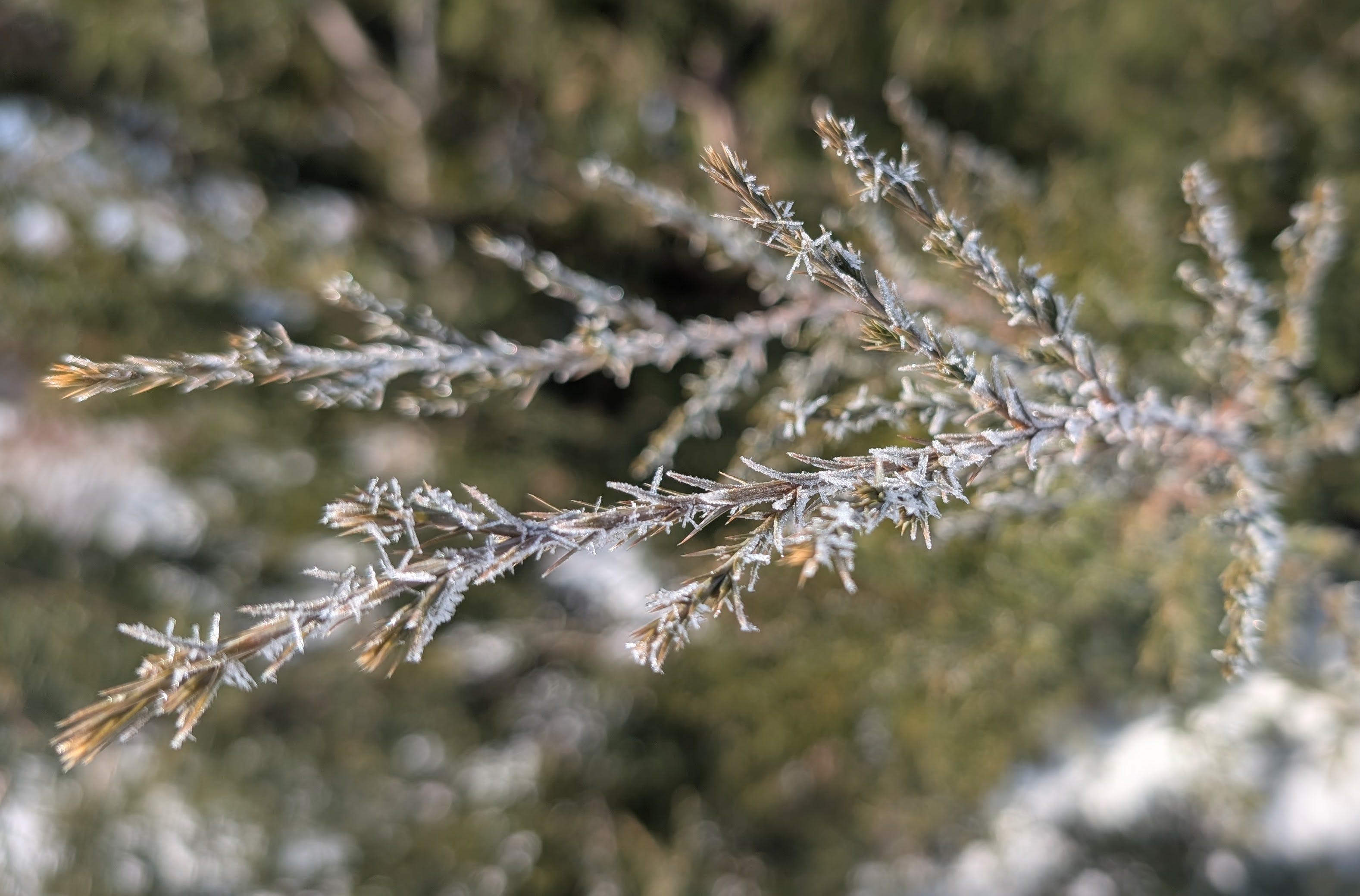
Frozen fractals clung to the red cedar branches. Like glitter brushed along a stage performer’s cheekbones, they shone only when the light hit just right. Hoarfrost had settled in during the overnight hours—tracing the needles in delicate prickly edging. I almost walked right past the fleeting spectacle. But I was strangely excited to see them on this particular evergreen branch. Only days before, that very tree had bowed low, nearly depleted under the weight of wet blizzard snow. I had worried the young cedar might succumb. And weeks before that, it had been a buffet to a flock of American robins. They picked every juniper berry off this tree which they could find. It was quite the season for this young cedar.
But it made it through.
And that frosty trim would be gone in a matter of minutes once the sun found it.
As I walked around the yard, the snow was softer underfoot. A cloudy haze hung in the sky—a warm haze mixed with fine particles of salt that had lived on the roads for weeks and were now lifting back into the air. The sky, gray, but with a warmness to it.
And in that haze, the birds seemed distracted. No, this morning was definitely a different vibe.
They didn’t track me from the hedgerow while I filled the feeders, the way they usually do. No immediate swoops once I stepped away. The feeders stayed heavy with seed all day, barely touched.
And at one point, I saw not just one Northern cardinals in the yard, but three. There is usually only one claiming this particular patch of the valley. Three felt like a small shift. A quiet quibble.
Later in the day, I swear I saw something flicker through the air—a moth, perhaps, or some other small insect stirred prematurely from the leaf litter. I couldn’t be sure. But something was testing the warmth.
We all were that day.
And then, it was over sooner than it started. Tiny ice pellets ping against the kitchen window. Not dramatic. Not beautiful. Just a quiet reminder.
So yes. I think we just experienced a false thaw.
A twelve-hour thaw that broke down the walls. Partially perhaps.
The birds were not absent—they were expanding in a different direction. Doing what we were doing. Leaving the confines of bricked rooms. Exploring softened ground and pliable air. Widening their range while they could. All winter they needed this place. Needed me, in some peripheral way. And one warm day, they all hopped on a train. And I'm still standing on the platform. It was a very empty platform that day.
All winter, the birds and I walked the same path. The feeders, the shelter, the familiar patch of valley. I was an inclusionary piece in their survival puzzle. I even started to notice a few…the junco missing his tail. The red-breasted nuthatch who dissed me when I offered a peanut with the skin still on. The skinny blue jay and 8 of her closest buds. The yellow-rumped warbler with a fancy for suet. And then one warm day, they just... didn't. The puzzle vanished in the haze. They expanded. They left. And there I was, with a full feeder feeling like I did something wrong. I felt vaguely abandoned by creatures that sort of felt like mine.
But that wasn’t it really. The birds took to the warmth the same way we needed to. They took it as a invitation to go out and explore. The exact same way the cyclists, dog walkers, and the people who found their shorts in a hurry.
So maybe the birds were not ignoring me so much. They were instead just widening their world on a warm day.
Hope does funny things after 54 degrees.
The birds will return to their predictable perches. The feeders will empty again. The cardinals will renegotiate territory. The insects will wait for consistency.
That strange pang of loneliness when I did not see my regular crew circulating their rotations between the feeders was only temporary. I am not just a person filling seeds into a feeder. I suppose I am the platform they return to.
And when the ice started to hit the windows at 7am, it seemed ok to be back inside with more winter, more blankets, more hot coffee. The birds were back at the feeders and I was back at inside the station, giving all the passengers names again.